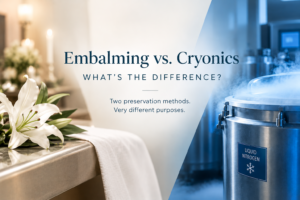

When people hear the words embalming and cryonics, they may assume both are simply different ways of preserving a body after death.
They are not.
Although both involve preservation, embalming and cryonics have very different purposes, methods, technologies, and expectations.
Understanding the difference can help families better understand what happens after death and what different forms of preservation actually mean.
What Is Embalming?
Embalming is a preservation procedure performed by trained and licensed funeral professionals.
Its primary purpose is not to preserve a person’s body forever. Instead, embalming temporarily slows the natural changes that occur after death.
Specialized preservative chemicals are used to delay decomposition, allowing families additional time for:
- Viewing their loved one
- Religious or cultural services
- Funeral ceremonies
- Final goodbyes
Embalming has been practiced for well over a century and remains one of the most commonly used preservation procedures in traditional funeral services.
The goal is ultimately about preservation for the present, helping families have time to say goodbye to their loved one in a dignified and respectful way.
What Is Cryonics?
Cryonics is an experimental approach to preserving the human body at extremely low temperatures.
Unlike embalming, cryonics is not primarily intended to prepare a body for a funeral or family viewing.
The concept behind cryonics is based on a hypothetical future possibility: that scientific and medical advances might someday make it possible to repair damage caused by disease and death and potentially restore biological function.
Cryonics involves cooling the body to extremely low temperatures, approximately -196°C (-321°F), using liquid nitrogen.
Before cooling, the blood is replaced with specialized solutions known as cryoprotectants. These are intended to help protect cells and tissues from damage associated with the formation of ice crystals during extreme cooling.
But there is an important distinction:
Cryonics remains experimental, and no human being has been successfully revived after cryonic preservation.
The possibility of future revival remains a theory rather than an established medical outcome.
Embalming vs. Cryonics: How Are They Different?
While both procedures involve preservation, they are designed to accomplish very different things.
- They Have Different Goals
Embalming focuses on the present.
It gives families time for mourning, viewing, visitation, and funeral services.
Cryonics focuses on a hypothetical future.
Its purpose is based on the possibility that future technologies could potentially restore biological function.
- They Use Different Chemicals
Both procedures involve chemicals, but those chemicals serve different purposes.
Embalming uses preservative solutions designed to slow decomposition.
Cryonics uses cryoprotectants designed to help protect tissues during extreme cooling.
This is one of the key differences between the two preservation processes.
- They Require Different Technology
Embalming requires specialized knowledge, professional training, and equipment used in funeral preparation.
Cryonics requires highly specialized technology, including:
Cryoprotective solutions
Extreme-temperature cooling systems
Liquid nitrogen
Long-term storage systems
Continuous maintenance at temperatures close to -196°C
The technological requirements and long-term objectives are therefore very different.
Why Is Timing Important?
In both embalming and cryonics, timing matters.
The sooner preservation begins after death, the greater the opportunity to maintain tissue integrity and reduce postmortem changes.
However, the reason timing matters is different depending on the procedure.
For embalming, timely preservation helps slow decomposition and allows families more time for funeral preparations and viewing.
For cryonics, preservation must occur as quickly as possible because the objective is to preserve biological structures for a potential future application.
Embalming and Cryonics Are Not the Same Procedure
It can be tempting to think of cryonics as an extremely advanced form of embalming.
But that isn’t an accurate way to understand either practice.
Embalming is a funeral preservation procedure designed to temporarily preserve the body for present-day purposes.
Cryonics is an experimental preservation practice based on a possible future application that has not yet been demonstrated in humans.
The two may share certain preservation concepts, but their goals, methods, technology, and expectations are fundamentally different.
A Simple Way to Understand the Difference
A Simple Way to Understand the Difference
Think of embalming as preservation for today.
The purpose is to help a family have time to:
Say goodbye.
Hold a funeral or memorial service.
View their loved one.
Honor and remember them.
Cryonics, on the other hand, is based on a possibility for tomorrow.
The concept is that preserving biological structures at extremely low temperatures might someday allow future technology to repair the damage associated with death.
That possibility has not been proven to work in humans.
Why Understanding the Difference Matters
Conversations about death care can sometimes become confusing, especially when new technologies and preservation methods are discussed online.
Understanding the difference between embalming, cryonics, cremation, and other forms of death care can help families make informed decisions and better understand what each option is actually designed to accomplish.
As a funeral director, embalmer, and cremationist, Shelly believes families deserve clear information about the science, purpose, and expectations behind these processes.
At Next Step Funeral Consulting, the goal is to provide families with information and guidance so they can better understand what happens after a death and what their next steps may be.
Want the Guide?
We’ve created a simple guide explaining the difference between embalming and cryonics, including their goals, preservation methods, chemistry, timing, and technology.
Download the free PDF guide:
Embalming vs. Cryonics: What’s the Difference?
Keep it for yourself or share it with someone who may find it helpful.